#1
Best Overall
Product Name
Product Description
- Feature
- Feature
- Feature
VIEW ON AMAZON
We may earn a commission from qualifying purchases.

Could a Daily Probiotic Help Seniors Feel More Comfortable After Meals?
Developed with doctors*
Loved by many
Unmatched quality
Product Description
We may earn a commission from qualifying purchases.
Better Digestion
Lorem ipsum dolor sit amet, consectetuer adipiscing elit.
Stronger Immunity
Lorem ipsum dolor sit amet, consectetuer adipiscing elit.
Everyday Wellness
Lorem ipsum dolor sit amet, consectetuer adipiscing elit.
Probiotics are live microorganisms that, when taken in adequate amounts, may confer health benefits to the person taking them. In plain English, they are beneficial bacteria or yeasts intended to support a healthier balance in the gut.
That definition matters because not every supplement labeled “probiotic” is equally useful. Experts emphasize that probiotic effects can be strain-specific, meaning one strain may help with one issue while another may not. A high CFU count alone does not guarantee results.
Still, for everyday consumers, a well-formulated probiotic can be a reasonable option when the goal is to support digestive regularity, reduce occasional bloating, or help the gut recover after disruption.
Digestive changes are common with age. Older adults may experience slower gut motility, changes in diet, medication use, reduced activity, and more frequent antibiotic exposure. All of these can affect regularity and comfort.
Research in older adults is especially encouraging for constipation-related symptoms. A 2023 systematic review and meta-analysis of geriatric patients found that probiotics reduced stool frequency compared with placebo. Other randomized trials in older adults have also reported improvements in functional constipation and bowel-related symptoms.
That does not mean every senior should automatically take any probiotic. It does mean that for seniors dealing with occasional constipation, irregularity, or digestive discomfort, probiotics are worth considering—especially if lifestyle steps like hydration, fiber, and movement have not fully helped.
One of the clearest areas of support is constipation. A 2024 systematic review and meta-analysis found that probiotic-containing products significantly increased stool frequency, improved stool consistency, and improved patient-reported constipation symptoms.
For a person who feels “backed up,” irregular, or uncomfortable because bowel movements are less predictable, this matters. Even modest improvements can make daily life feel easier.
This is particularly relevant for seniors, where constipation is common and can be tied to diet, medications, hydration, and reduced mobility.
Bloating is one of the most common reasons people try probiotics. The research is more mixed here than for constipation, but there is support for selected probiotics improving bloating and overall symptoms in some people with irritable bowel syndrome.
The World Gastroenterology Organization notes that reduced bloating and flatulence are consistent findings in some probiotic research, though results depend on strain and condition.
In practical terms, probiotics may be most reasonable for people who regularly feel bloated after eating and want a low-risk supplement to test as part of a broader digestive routine.
Antibiotics can disrupt the gut microbiome. That disruption is one reason some people develop diarrhea during or after antibiotic use.
A 2021 systematic review and meta-analysis found that probiotics reduced the risk of antibiotic-associated diarrhea in adults. Another meta-analysis found that Saccharomyces boulardii, a probiotic yeast, reduced the risk of antibiotic-associated diarrhea.
This does not mean probiotics should replace medical advice during antibiotic treatment. But for many adults, especially those with a history of digestive upset after antibiotics, asking a clinician about probiotic use may be worthwhile.
Many people are not dealing with a formal diagnosis. They simply feel off: occasional gas, inconsistent bowel habits, discomfort after meals, or a sense that their digestion is not as smooth as it used to be.
This is where probiotics can fit into a daily wellness routine. They are not a cure-all, but they may help support a healthier gut environment, especially when combined with fiber-rich foods, hydration, regular meals, and movement.
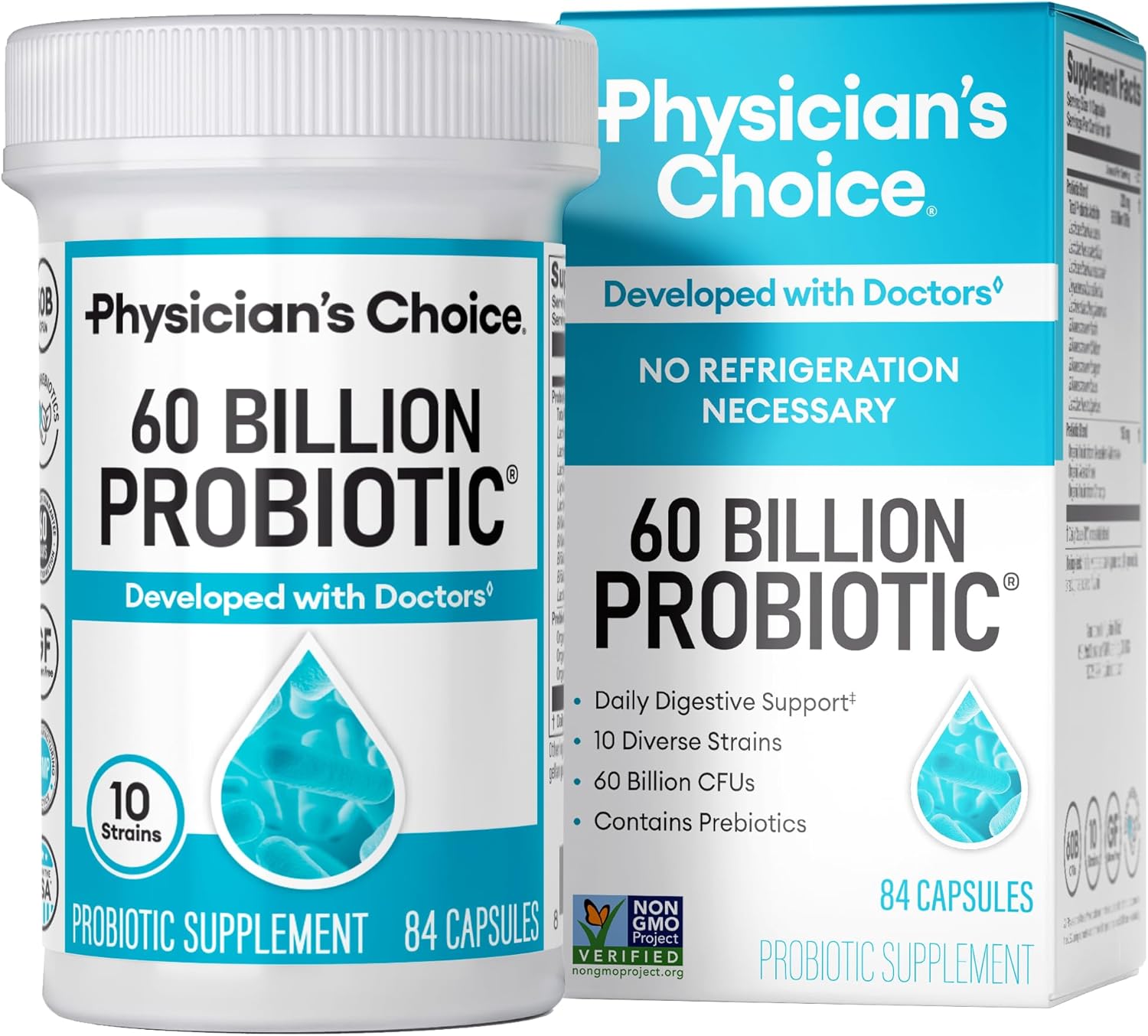
The product reviewed in the original research was Physician’s CHOICE Probiotics 60 Billion CFU, 10 Strains + Organic Prebiotics, sold on Amazon.
Customer reviews are not clinical trials, so they should not be treated as proof. They are, however, useful for understanding what real people notice when they take the product.
Across the Amazon review themes, customers commonly reported:
Some reviewers reported improvement within 1 to 2 weeks. Others said the benefits were gradual rather than immediate. A minority of users reported negative digestive effects such as gas, stomach discomfort, or diarrhea.
That mixed experience is important. Probiotics work differently from person to person. A product that feels gentle and effective for one customer may not agree with another person’s digestive system.
Still, the overall consumer pattern was consistent with the research: many people use probiotics to help with bloating, irregularity, and digestive comfort.
Physician’s CHOICE Probiotics 60 Billion CFU is marketed as a general digestive health probiotic for women and men. Its appeal comes from several consumer-friendly features:
Prebiotics are fibers or compounds that help feed beneficial gut bacteria. Many consumers like the idea of combining probiotics and prebiotics in a single capsule.
Not needing refrigeration makes the product easier to keep in a cabinet, pack while traveling, or take consistently.
The product is marketed as using capsules designed to help probiotics survive stomach acid and reach the intestines.
For seniors or busy adults, a once-daily capsule is easier than complicated supplement routines.
The product is positioned around occasional constipation, diarrhea, gas, and bloating—the same issues many probiotic shoppers are actively trying to manage.
The strongest everyday benefit is improved bowel regularity, especially for people with occasional constipation or inconsistent bowel habits.
Some people report less bloating, less gas, and a calmer stomach after consistent use. Research on IBS and bloating is mixed but supportive for selected strains.
Evidence supports certain probiotics for reducing the risk of antibiotic-associated diarrhea, especially when started early and used appropriately.
For most healthy adults, probiotics are generally well tolerated. Temporary gas or digestive adjustment may happen, especially when first starting.
Unlike major diet changes, a probiotic capsule is simple. That matters because consistency is often what determines whether a supplement trial is useful.
Experts repeatedly stress that probiotic benefits depend on strain, dose, and indication. A label with a large CFU number does not automatically mean the product will work better.
Some people feel better. Some feel no difference. Others may feel worse. A fair trial may take a few weeks, but the product should be stopped if symptoms worsen.
Gas, bloating, stomach discomfort, or diarrhea can occur. These effects are often temporary, but not always.
People who are immunocompromised, severely ill, have central venous catheters, or have serious underlying medical conditions should not casually start probiotics without medical guidance. Rare invasive infections have been reported in vulnerable patients.
In the United States, dietary supplements do not require the same premarket FDA approval for effectiveness as medications. That makes product quality, labeling, and brand trust more important.
For someone considering a probiotic for digestive comfort, the most reasonable approach is a structured trial.
Start with a clear goal. For example: “I want to be more regular,” “I want less bloating after meals,” or “I want digestive support after antibiotics.”
Take it as directed on the label. Do not judge the product after one capsule. Many users and studies suggest that benefits may take days to weeks.
Track how you feel. Pay attention to bowel frequency, bloating, gas, urgency, and post-meal comfort.
Stop if symptoms worsen. More discomfort, severe diarrhea, allergic symptoms, or unusual reactions should be taken seriously.
Talk to a clinician if you are older, medically complex, or taking antibiotics. Seniors can benefit from probiotics, but the safest choice is to involve a healthcare professional when health conditions or medications are involved.
A daily probiotic may be a good fit for adults who:
For seniors, the most research-supported use appears to be constipation and bowel regularity support. That makes probiotics especially relevant for older adults who want a gentle daily option before turning to harsher approaches.
The most honest conclusion is also the most useful: probiotics are not a miracle cure, but they are among the more reasonable supplements to consider for common digestive complaints.
Research supports the use of probiotics for several digestive issues, including reducing the risk of antibiotic-associated diarrhea, occasional constipation, and selected symptoms such as bloating and IBS-related discomfort. In older adults, evidence is particularly encouraging for constipation and regularity.
Customer reviews for Physician’s CHOICE Probiotics 60 Billion CFU are broadly consistent with that picture. Many people report better digestion, less bloating, and improved regularity, while some experience no benefit or digestive side effects.
For people dealing with ongoing digestive discomfort, a probiotic may be worth a careful, consistent trial—especially when paired with good hydration, fiber, movement, and sensible eating habits.
The key is to choose thoughtfully, manage expectations, and treat probiotics as targeted digestive support rather than a cure-all.
Barnes, E. L., Agrawal, M., Syal, G., Ananthakrishnan, A. N., Cohen, B. L., Haydek, J. P., Al Kazzi, E. S., Eisenstein, S., Hashash, J. G., Sultan, S. S., Raffals, L. E., & Singh, S. (2024). AGA clinical practice guideline on the management of pouchitis and inflammatory pouch disorders. Gastroenterology, 166(1), 59–85.
Deng, X., Shang, X., Zhou, L., Li, X., Guo, K., Xu, M., Hou, L., Hui, X., & Li, S. (2023). Efficacy and safety of probiotics in geriatric patients with constipation: Systematic review and meta-analysis. The Journal of Nutrition, Health & Aging, 27(11), 1140–1146.
Ding, F., Hu, M., Ding, Y., Meng, Y., & Zhao, Y. (2024). Efficacy in bowel movement and change of gut microbiota on adult functional constipation patients treated with probiotics-containing products: A systematic review and meta-analysis. BMJ Open, 14, e074557.
Goodman, C., Keating, G., Georgousopoulou, E., Hespe, C., & Levett, K. (2021). Probiotics for the prevention of antibiotic-associated diarrhoea: A systematic review and meta-analysis. BMJ Open, 11(8), e043054.
Goodoory, V. C., Khasawneh, M., Black, C. J., Quigley, E. M. M., Moayyedi, P., & Ford, A. C. (2023). Efficacy of probiotics in irritable bowel syndrome: Systematic review and meta-analysis. Gastroenterology, 165(5), 1206–1218.
Guarner, F., Sanders, M. E., Szajewska, H., Cohen, H., Eliakim, R., Herrera, C., Karakan, T., Merenstein, D., Piscoya, A., Ramakrishna, B., & Salminen, S. (2023). World Gastroenterology Organisation global guidelines: Probiotics and prebiotics.
Hill, C., Guarner, F., Reid, G., Gibson, G. R., Merenstein, D. J., Pot, B., Morelli, L., Canani, R. B., Flint, H. J., Salminen, S., Calder, P. C., & Sanders, M. E. (2014). Expert consensus document: The International Scientific Association for Probiotics and Prebiotics consensus statement on the scope and appropriate use of the term probiotic. Nature Reviews Gastroenterology & Hepatology, 11(8), 506–514.
National Institutes of Health Office of Dietary Supplements. (2025). Probiotics: Health professional fact sheet.
U.S. Food and Drug Administration. (n.d.). Questions and answers on dietary supplements.